

Cybersecurity
Connected product security: check before placing on the market
A security defect costs little to fix at the design stage and a great deal once the product is installed at your customers. We examine your product before it leaves.
The subject
Why, and for whom
Network side
- Remote services
- Exchanges with the network
- Update mechanism
- Firmware
- Maintenance interfaces
- Circuit board
Hardware side
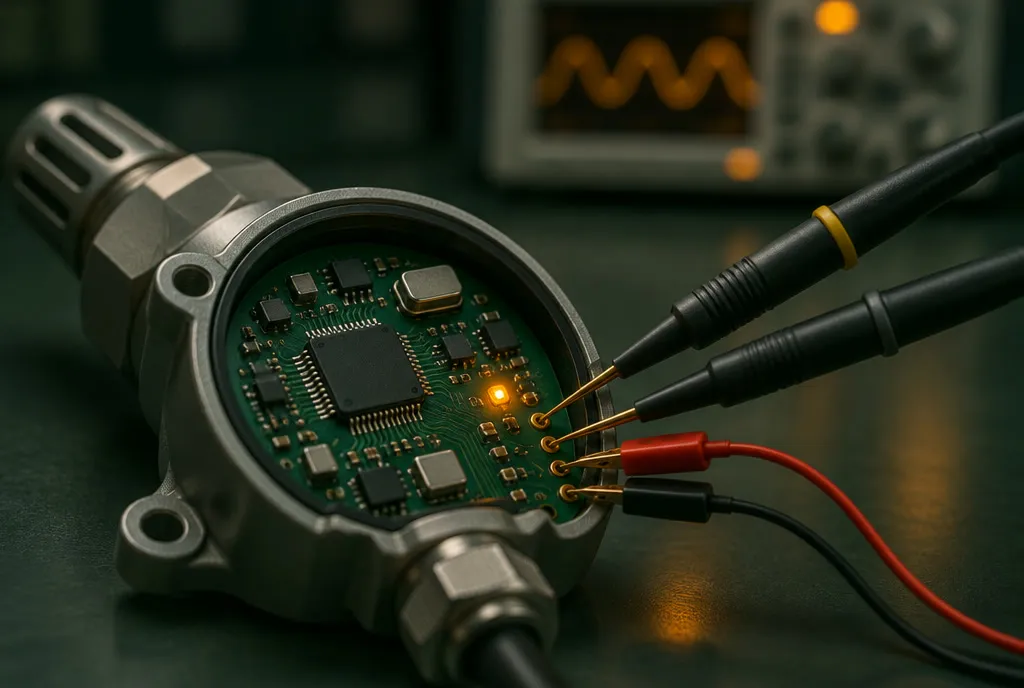
A connected product is judged on the whole chain: the board, the firmware, the maintenance interfaces, the exchanges with the network and the remote services, the update mechanism. A weakness at just one of these points is enough.
The product security review is intended for design teams. Its conclusions are written to be applied, and they feed directly into the file required by the Cyber Resilience Act.
- Manufacturers preparing the launch of a connected product or of a new version.
- Engineering firms that want an outside view before series production.
- Industrial companies that integrate connected equipment and want to check its level of security.
Scope
What we examine
- Architecture and threat model
- Who can reach what, by what path, and with what consequences: the basis of every design decision.
- Firmware
- Embedded components, hard-coded secrets, active protections and update mechanism.
- Interfaces and communications
- Maintenance ports, radio links, protocols and exchanges with the remote services.
- Software components
- Inventory of components (SBOM) and the known vulnerabilities that affect them.
- Checks on the product
- Tests carried out on your units, within the limits you have authorised in writing.
Deliverables
What you receive
- A review report: findings ranked by severity, with their evidence.
- Design recommendations, written for your development teams.
- The inventory of the software components of the product (SBOM).
- The elements that can be reused in your CRA compliance file.
Process
How the engagement runs
-
Scoping
Product, version, objectives and limits of the review.
-
Written authorisation
The scope of the checks is set in writing before any test.
-
Review and checks
Document analysis, firmware analysis, checks on the product.
-
Debrief
Presentation of the findings and the recommendations to your teams.
Frequently asked questions
What we are asked most often
At what point in the project should the review be done?
As early as possible. An architecture review can be done from the design stage; the checks on the product require a representative prototype. The two phases can be separated.
Do we have to provide the source code?
It is not essential, but the review is more complete and faster with the design documentation and, if possible, the sources. The confidentiality terms are set in the contract.
Does the review amount to CRA compliance?
No, but it produces several of its components: risk assessment, inventory of components, evidence of verification. It ties in with our CRA compliance support.
Further reading
Our other services
See also
Penetration testing
Your applications, networks, installations and equipment put to the test under written terms: what a third party can actually obtain, with the evidence and the fixes.
View the serviceExternal exposure audit
What your company shows on the Internet, checked with your agreement, and a remediation plan ranked by priority.
View the serviceOSINT audit
What open sources reveal about your company and its executives: data leaks, credentials, documents, public accounts.
View the serviceNIS2 compliance
The NIS2 Directive extends cybersecurity obligations to eighteen sectors and, by contract, to their suppliers. Find out whether you are concerned, then prepare.
View the serviceCyber Resilience Act compliance
The Cyber Resilience Act makes the placing on the market of connected products conditional on compliance. We prepare your products and your file.
View the serviceCyber risk management
Identify your cyber risks, rank them, decide what to treat: a risk analysis and a register that management can steer by.
View the serviceAutomation
Design, integration and maintenance of bespoke automated systems, with their security considered from the outset.
View the serviceLet’s talk about what you need.
Describe your situation in a few lines: we will come back to you with a scoping proposal and a fixed-price quote.